Most five a side tournaments are decided by three numbers the organiser cannot change: how many teams have entered, how many pitches are booked, and how many hours the booking runs. The format is the thing you can change, and picking the right one is the difference between a day that ends with a final at four o'clock and one where the last group game kicks off as the lights go off.
This guide covers the four formats that work for five a side, the entry sizes each one suits, and a worked plan for the most common setup, 16 teams on three pitches.
Start with the numbers you cannot change
Five a side matches are short, which is what makes a full tournament possible in a day. A match of 10 to 12 minutes with a 3 minute turnaround gives you 15 minute slots, which is the unit everything below is planned in.
Then it is arithmetic. Three pitches at 15 minute slots is 12 matches an hour. A four hour booking is 48 matches, and that number, minus a break and a final, is the ceiling for your format.
- Two pitches, four hours: about 30 matches after breaks
- Three pitches, four hours: about 45 matches after breaks
- Four pitches, four hours: about 60 matches after breaks
Work this out before you open registration, because it caps how many teams you can honestly take.
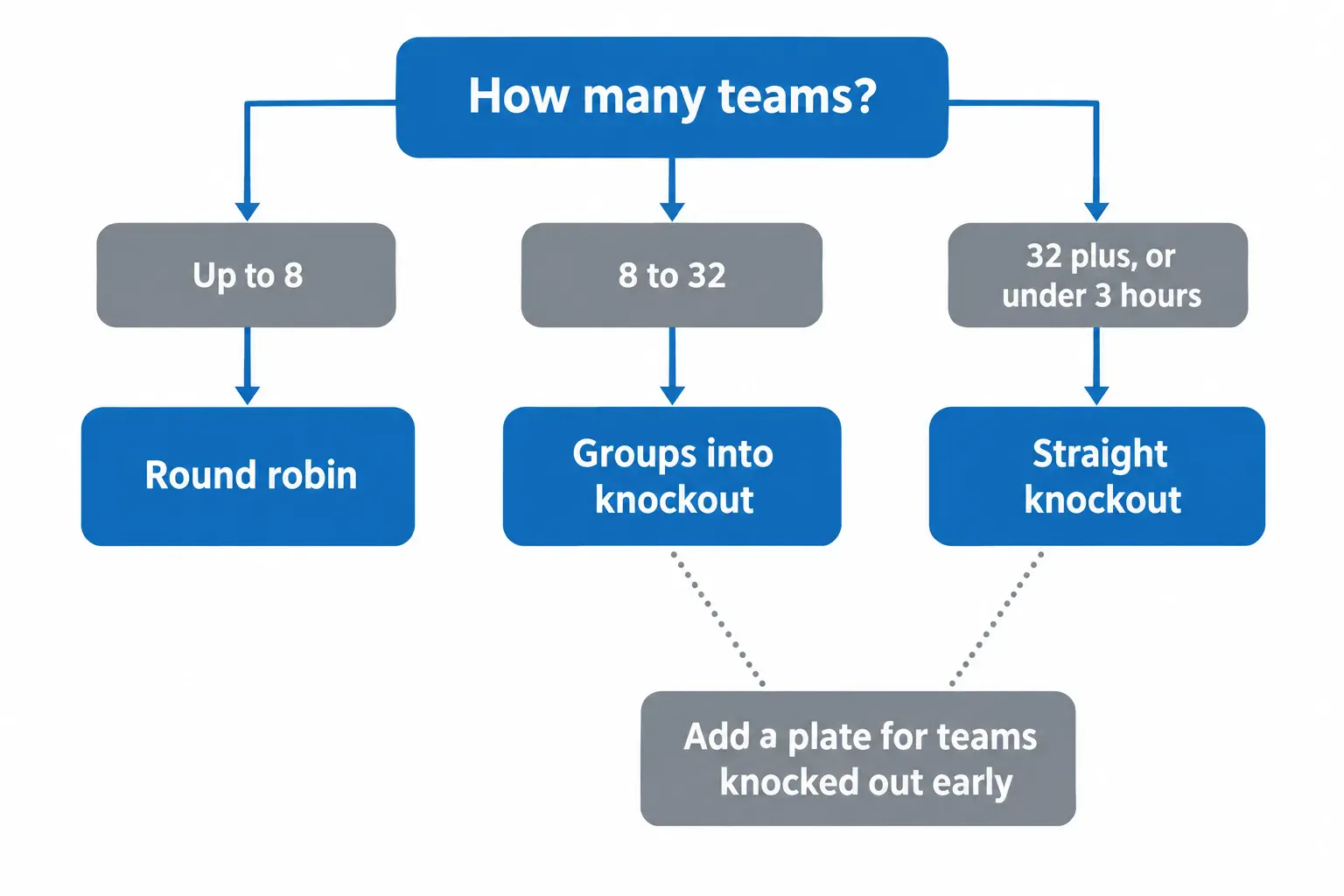
Round robin: up to 8 teams
Every team plays every other team once. Six teams is 15 matches, eight is 28. Nobody goes home early and the winner is the team at the top of the table.
Right for a work tournament, a club social or a small charity day where the point is that everyone plays. Wrong past eight teams, because the match count outgrows the booking. The round robin guide has the full numbers.
Groups into knockout: 8 to 32 teams
Split the entry into groups of four, play a round robin inside each group, and send the top two into a knockout. Every team gets three group games, the day ends with a final, and the match count stays manageable. Sixteen teams is 31 matches including a third place game, which fits three pitches in about three and a half hours.
This is the format most five a side tournaments use, and for good reason. The group stage to knockout guide covers the group sizes, qualification rules and tie-breakers.
Straight knockout: when time is short or the entry is huge
One loss and you are out. Thirty two teams is 31 matches, the same as a 16 team group format, so it is the way to run a big entry in a short booking.
The cost is obvious: half the teams play once and go home. For a charity tournament where teams have paid to enter, that lands badly. If you run a straight knockout, run a plate alongside it so that first round losers get a second competition.
Plate: the fix for early exits
A plate is a second knockout for teams eliminated from the main competition, usually the group stage non qualifiers or the first round losers. It runs on the same pitches in the same afternoon, so every team is still playing at three o'clock and the bar stays busy.
Scoryboard supports plate and cup competitions from the same tournament setup, so the plate draw is generated from the group results rather than done by hand.
A worked plan: 16 teams on three pitches
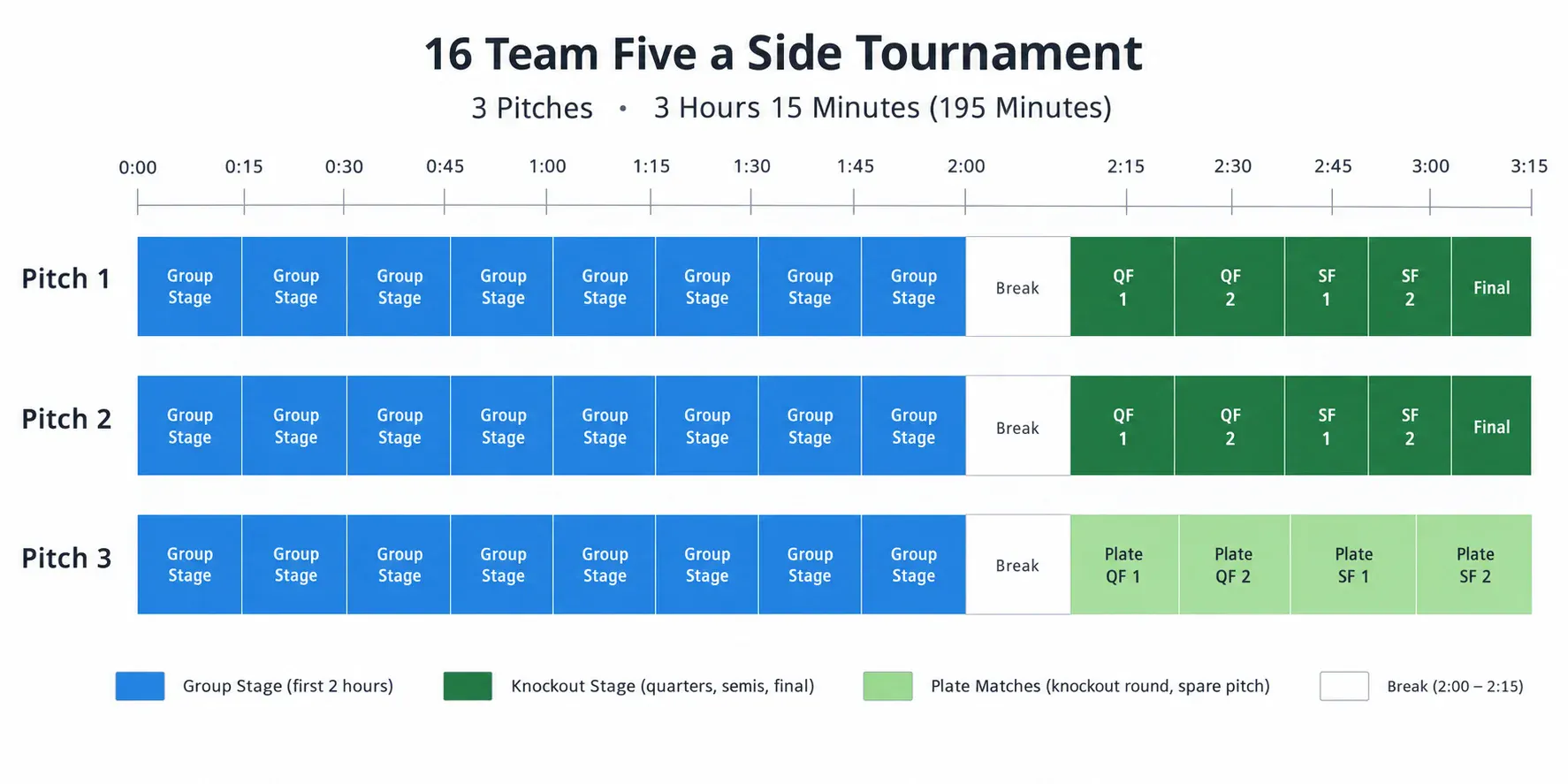
This is the setup most organisers end up with, so here it is in full at 15 minute slots.
- Group stage. Four groups of four, 24 matches. Three pitches run eight slots, which is two hours.
- Break. Fifteen minutes. Put it after the group stage, not at a clock time.
- Quarter finals. Four matches across three pitches, two slots, thirty minutes.
- Semi finals. Two matches, one slot, fifteen minutes.
- Third place and final. Both in one slot, fifteen minutes.
Total: three hours and fifteen minutes, with a plate competition for the eight non qualifiers running on the spare pitch during the knockout rounds. A four hour booking covers it with time for presentations.
Running the day, not just the format
The format decides whether the day fits. Three other things decide whether it runs.
- Registration and entry fees. Take the entry fee at registration, not on the day. A team that has paid turns up. Scoryboard's online registration collects the fee when the team signs up, with custom forms for squad lists and contact details.
- Live standings. Teams checking a printed sheet at the organiser's table slows everything down. Put the group tables on the tournament page and the big screen, updated as scores go in.
- Sponsors. A local sponsor covering the pitch hire wants to be seen. The big screen slideshow rotates sponsor logos between the standings, which is the cheapest way to keep them happy for next year.
Where to start
Confirm pitches and hours, run the arithmetic, and take that many teams. Then set the format in the fixture generator, add your pitches and match length, and let it build the schedule. The free plan covers up to 8 teams, and one payment of £19.99 covers the whole tournament with unlimited teams. The football page covers the rest of what the platform does for the sport.
Build your five a side tournament
Frequently asked questions
How long should a five a side tournament match be?
Ten to twelve minutes straight through, no half time, with three minutes to clear the pitch. That gives 15 minute slots, which is what the timings above are built on. Finals can run longer.
How many teams can I fit in a four hour booking?
On three pitches, around 16 teams in a group and knockout format with a plate, or up to 32 in a straight knockout. On two pitches, 12 teams in groups is comfortable, 16 is tight.
What format works for a charity five a side tournament?
Groups into knockout with a plate. Every team gets at least three games and nobody who paid an entry fee goes home after one match, which matters more for a charity event than a quick final.
Should I run a plate competition?
If the format knocks teams out, yes. It costs nothing extra in pitch time if it runs on the spare pitch during the knockout rounds, and it keeps half your entry on site for the afternoon.
Do I need referees for every match?
Most grassroots five a side tournaments use one referee per pitch. Three pitches means three referees for the day, plus a spare if the budget allows. Scoryboard lets you assign referees to fixtures in the schedule so each one knows which pitch they are on.