Round robin is the simplest tournament format there is. Every team plays every other team, points are added up, and the team at the top of the table wins. There is no draw to argue about, no bracket to seed, and no team goes home after one bad game.
The catch is that the number of matches grows fast. Six teams is comfortable. Twelve teams is 66 matches, which is a season, not a Sunday. This guide sets out what round robin costs in matches and pitch time, how to schedule it so it runs cleanly, and the point at which you should switch to a group stage instead.
How the format works
Each team plays every other team once. A win is usually worth three points and a draw one, though some sports and some organisers use two and one. When every match has been played, the table decides the winner. If two teams finish level, a tie-breaker order settles it, and that order should be published before the first game rather than decided at the end.
That is the whole format. Its strength is that it is fair in a way no knockout can be: the winner is the team that did best across every opponent, not the team that avoided the strongest side in the draw.
How many matches and rounds it takes
The total number of matches for n teams is n × (n − 1) ÷ 2. The number of rounds is one fewer than the number of teams if the number is even, and equal to the number of teams if it is odd, because one team sits out each round.
- 4 teams: 6 matches, 3 rounds
- 5 teams: 10 matches, 5 rounds with a bye each round
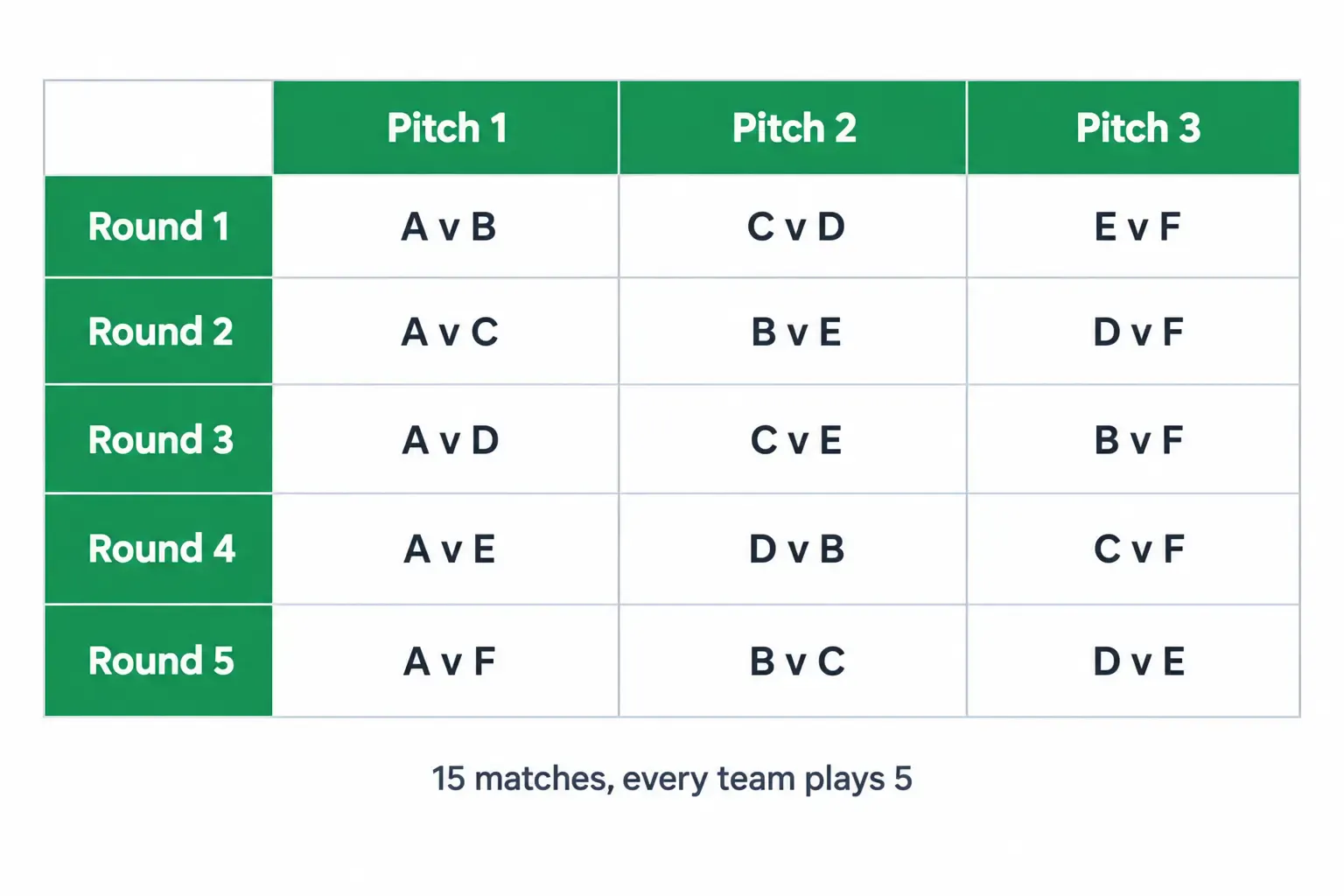
- 6 teams: 15 matches, 5 rounds
- 8 teams: 28 matches, 7 rounds
- 10 teams: 45 matches, 9 rounds
- 12 teams: 66 matches, 11 rounds
Every team plays one fewer match than the number of teams. In a 6 team round robin each team plays five games, which for most one day events is the most anyone wants.
When round robin is the right choice
Round robin suits a competition when three things are true.
- The entry is small. Up to six teams, sometimes eight, on a one day event. Beyond that the match count takes over the day.
- Everyone wants to play. A social tournament, a club day, a youth festival. Nobody wants to travel an hour and go home after one match.
- Fairness matters more than a final. If the point is to find the best team over a day rather than to have a showpiece at the end, round robin gets there more reliably than any bracket.
It also works for a full season. A league is a round robin stretched over months, usually played twice as home and away. The league fixture list guide covers that version.
When to switch to a group stage
Past eight teams, round robin stops fitting a day. Twelve teams at 15 minute slots is 66 matches, which is over five hours on three pitches and over eight on two, before breaks.
The usual answer is to split the entry into groups of three or four, run a round robin inside each group, and send the top teams into a knockout. Every team still gets three or four games, the day still ends with a final, and the match count roughly halves. The group stage to knockout guide walks through that format with the numbers.

Scheduling a round robin across pitches
The nice property of round robin is that each round is a set of matches that can all run at the same time. With six teams there are three matches per round, so three pitches play the whole round at once and the tournament runs in five slots. Two pitches means one match waits each round, and the day takes eight slots instead of five.
Three things to get right:
- Rest. Alternate which pitch each team plays on so nobody plays back to back on the same pitch while another team waits forty minutes.
- Breaks. Put one after round three, not at a fixed time. A schedule that says "break at 12:00" is wrong by 11:40.
- The last round. If the title is still open, the final round of matches should kick off together so no team knows what result it needs.
Scoryboard's fixture generator builds the round robin schedule around your pitches and match length, spreads the fixtures so no team plays consecutively, and lets you add breaks and awards as events in the schedule rather than working around them.
Points, standings and tie-breakers
Round robin lives or dies on the table, so decide the points system and the tie-breaker order before the first match and put both on the tournament page.
The common tie-breaker order is points, then goal difference, then goals scored, then the head to head result between the tied teams, then a drawing of lots or a penalty shoot out. Scoryboard applies whichever order you set when it calculates the standings, so the table on the big screen is already correct when the last game ends.
Variations worth knowing
- Double round robin. Every team plays every other team twice, home and away. This is the standard league format and doubles the match count.
- Americano and Mexicano. Round robin formats for padel and other racket sports where pairs rotate every round and points are counted per game rather than per match. Scoryboard supports both on its padel and table tennis pages.
- Round robin into a final. The top two from a small round robin play one extra match for the title. It adds a showpiece without adding a full knockout.
Where to start
Count the teams, run the match number, and check it against your pitches and hours. Up to eight teams, set the format to round robin in the fixture generator, add your pitches and match length, and let it build the schedule. Above eight, read the group stage guide first.
The free plan covers up to 8 teams, and one payment of £19.99 covers the whole competition with unlimited teams.
Frequently asked questions
How many matches are in a round robin tournament?
Multiply the number of teams by one fewer than that number, then divide by two. Six teams is 15 matches, eight teams is 28, ten teams is 45.
What is the maximum number of teams for a round robin?
For a one day event, eight is the practical limit at 28 matches. Beyond that, split into groups. For a league played over a season there is no real limit, and 12 to 16 team leagues are common.
What happens with an odd number of teams?
One team sits out each round, which is called a bye. Five teams means five rounds with one bye per round, and every team has one free round.
Is round robin fairer than a knockout?
For finding the best team, yes. Every team faces every opponent, so a single bad result or an unlucky draw does not end the day. A knockout is quicker and gives you a final, which is why most bigger tournaments combine the two.
Can I run a round robin and still have a final?
Yes. Play the round robin, then have the top two play one extra match for the title. It keeps the fairness of the table and gives the day an ending.