A league fixture list has one job that sounds simple and is not. Every team has to play every other team, the same number of times, spread across the season so that nobody plays twice in a week, with a fair split of home and away, on pitches that are actually available. Get one of those wrong and you will hear about it by the second week.
This guide shows the method for building one properly, the numbers for the league sizes most grassroots clubs run, and the point at which it stops being worth doing by hand.
What a fixture list has to get right
Before writing a single fixture, it helps to be clear on the four things a good list does.
- Complete. Every team plays every other team once, or twice if you are running home and away.
- Balanced. No team plays two matches in one round, and no team sits out more than it has to.
- Fair on venues. Home and away alternate as closely as possible, and no team plays three away games in a row.
- Possible. Every fixture lands on a date when both teams and the pitch are free.
The first two are maths and there is a method for them. The last two are judgement and local knowledge, and no method replaces knowing that the 3G pitch is booked for a cup final on the fourth Saturday.
How many rounds and matches you will need
Work this out first, because it tells you whether the season fits the dates you have.
With an even number of teams, a single round robin takes one round fewer than the number of teams, and every team plays in every round. With an odd number, it takes as many rounds as there are teams, and one team sits out each round. The total number of matches is always n × (n − 1) ÷ 2. Double all of it for home and away.
For a home and away season:
- 6 teams: 10 rounds, 30 matches
- 8 teams: 14 rounds, 56 matches
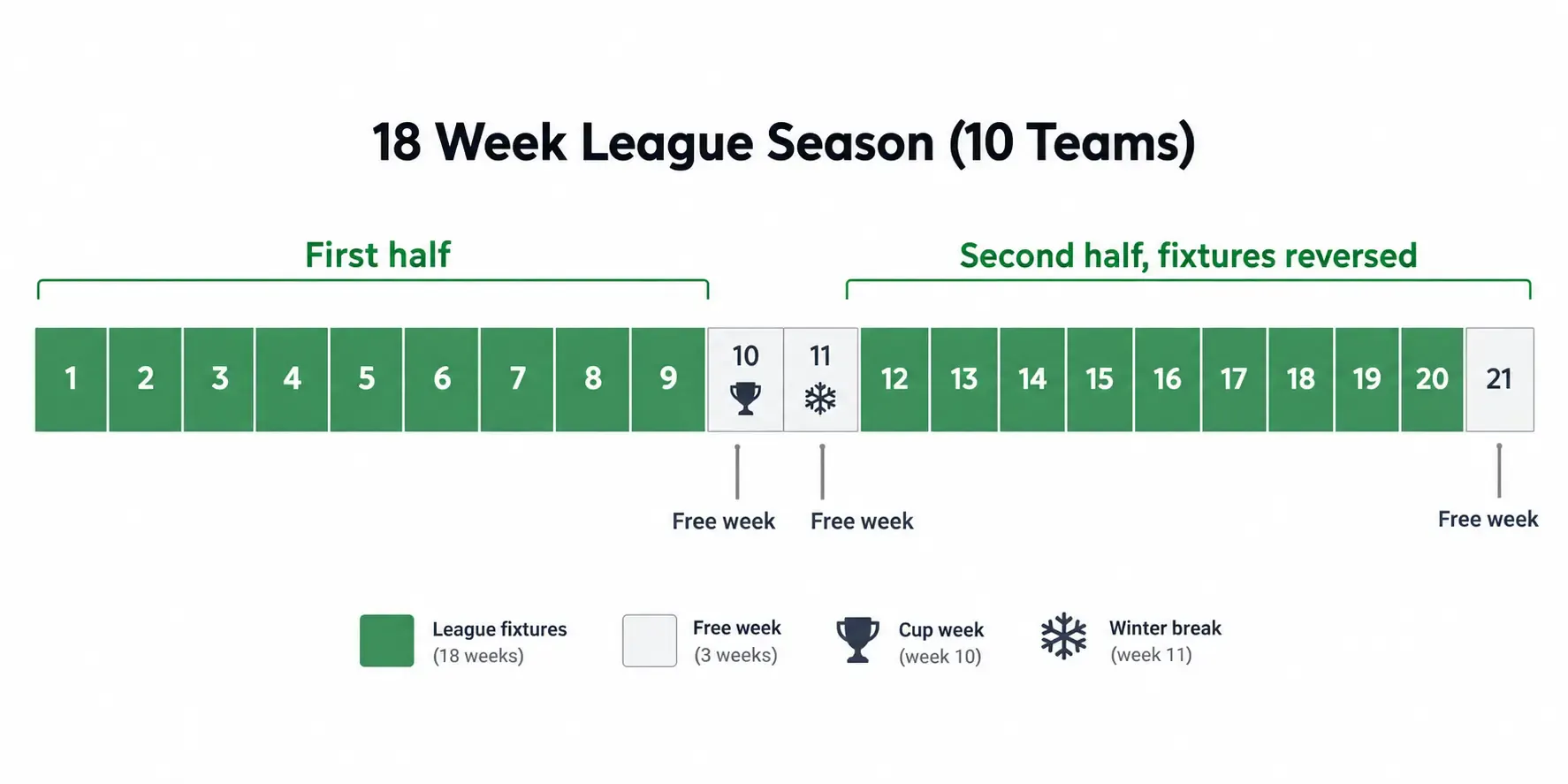
- 10 teams: 18 rounds, 90 matches
- 12 teams: 22 rounds, 132 matches
A 10 team league playing once a week needs 18 match weeks. Add two or three free weeks for cup ties, bad weather and Christmas and you are at 21 weeks, which is the number to check against the pitch booking before anything else.
The circle method, step by step
This is the standard way to build a round robin by hand, and it is worth understanding even if you end up using a generator, because it explains why a fixture list looks the way it does.
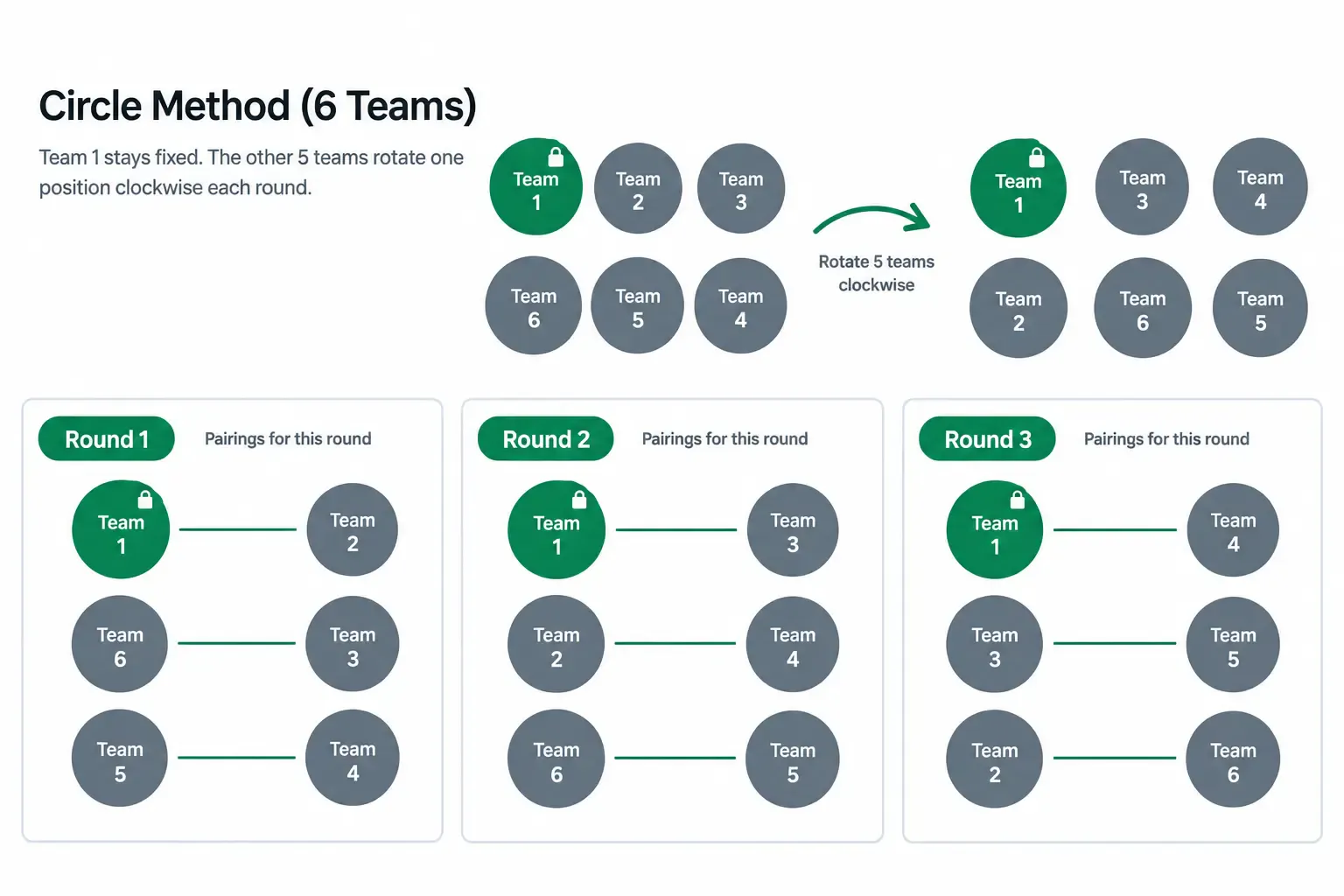
- Write the teams in two rows, half on top and half underneath, so each column is a fixture.
- Fix the team in the top left corner. It never moves.
- For the next round, rotate every other team one place clockwise around the fixed team.
- Repeat until you have one round fewer than the number of teams. Every pairing will have appeared exactly once.
- For home and away, copy the whole set of rounds and swap home and away in the copy.
For six teams that gives five rounds of three matches. The rotation guarantees completeness and balance, which are the two things that are hard to check by eye once the league gets past eight teams.
Odd numbers and byes
With an odd number of teams, add a placeholder called Bye and run the circle method as if it were a team. Whoever draws the Bye that round sits out. Nine teams become ten, the season runs nine rounds, and every team has one free round.
Tell the clubs which round their bye falls in before the season starts. A team that finds out on the Thursday that it has no game on Saturday will assume you forgot them.
Home and away balance
The circle method gives you the pairings, not the venues. Assigning home and away is a separate pass, and the rule most leagues use is simple: each team alternates home and away as far as possible, and the second half of the season reverses the first. That means the team that was home in week 1 is away in the reverse fixture, and nobody gets a run of three away games.
Where two teams share a ground, or one team has no pitch of its own, that is where the list starts needing manual adjustment. Do it after the pairings are set, not before, or you will break the balance.
Dates, pitches and the things that go wrong
Once the pairings and venues are set, the fixtures go onto real dates, and this is where most lists fail. The usual causes:
- Cup weekends. The county cup, the district cup and the league cup all take Saturdays. Block them before the fixtures go on.
- Shared pitches. Two home teams on one ground on the same day cannot both play at 2pm. Stagger kick offs or swap a fixture.
- Bad weather. Keep at least two free weeks in the second half of the season for postponements, or the last round will be played in May.
- Late entries and withdrawals. A team dropping out in week 3 leaves a hole in every round it was in. Have the plan for expunging its results agreed before it happens.
None of this is hard on its own. It is hard when you are holding all of it in a spreadsheet and one change moves nine other fixtures.
Where a generator saves the work
The circle method takes ten minutes for six teams and an afternoon for twelve, and every change afterwards costs as much again. Scoryboard’s fixture generator does the pairings, the byes and the home and away split in one pass, builds the schedule around the venues and pitches you give it, and lets you drag any fixture to a different date when a cup tie lands on it. The league page then publishes the fixtures and keeps the standings updated as results come in.
The free plan covers a league of up to 8 teams. A single payment of £19.99 covers the whole season with unlimited teams, however many rounds it runs.
Frequently asked questions
Is there a free league fixture generator?
Yes. Scoryboard’s fixture generator is free for leagues of up to 8 teams, with no card required. Larger leagues are a one off £19.99 for the season.
How many weeks does a 10 team league take?
Eighteen match weeks for home and away, nine for a single round. Add two or three free weeks for cups and postponements before you confirm the pitch booking.
What happens if a team drops out mid season?
Most leagues expunge that team’s results if it leaves before the halfway point, and keep them if it leaves after. Decide the rule in advance and write it into the league rules so it is not argued about in March.
Can I export the fixture list?
Yes. Scoryboard exports fixtures and standings to PDF and CSV, so the list can go on a noticeboard or into a club newsletter as well as living on the league page.
Do I need to reverse every fixture for the second half?
Only if you are running home and away. A single round robin has no second half. If you are, reversing the whole first half is the fairest way to do it, because it keeps the home and away balance the circle method gave you.