Group stage into knockout is the format most grassroots organisers end up choosing once a tournament gets past eight teams, and for a good reason. Every team gets a guaranteed run of matches before anyone goes home, and the day still finishes with a final that people stay to watch. It is the format the World Cup uses, and it is the format that works for a Sunday cup at the local sports centre.
The trouble is that it takes more planning than a straight knockout. You have to decide how many groups to run, how many teams go through, and how many matches that adds up to before you know whether it fits in the time you have booked. This guide walks through those decisions with the actual numbers.
How the format works
Teams are split into groups, usually of four. Inside each group every team plays every other team once, which is a small round robin. Points are awarded for wins and draws, and the group table decides who goes through. The top teams from each group then move into a knockout bracket, where one loss ends your day, all the way to the final.
The two halves do different jobs. The group stage makes the day fair, because a team cannot be eliminated by one bad result. The knockout stage makes the day worth staying for, because there is a final.

How many groups, and how many qualify
Group size decides how many games every team is guaranteed, so pick it first.
- Groups of four are the default. Every team gets three matches and the group divides cleanly into a knockout.
- Groups of three work when numbers are awkward, but every team only gets two games and one result can decide the group.
- Groups of five give everyone four matches, which is usually too many for a one day event.
The usual rule is that half the group qualifies: two from four, or two from three. Sending more than half through takes the pressure out of the group stage, and the first knockout round ends up full of teams that have already lost twice.
When the maths does not work out, the best third placed teams fill the gap. Twelve teams in three groups of four gives you six automatic qualifiers, so the two best third placed teams make up the eight you need for quarter finals.
How many matches you will need
This is the number that decides whether your format fits the day, so work it out before anything else.
Each group of n teams plays n × (n − 1) ÷ 2 matches. A group of four plays six matches, a group of three plays three. The knockout stage needs one fewer match than the number of qualifiers, plus one more if you want a third place play off.
For the four most common entry sizes, including a third place match:
- 8 teams: 2 groups of 4, 12 group matches, 4 qualify, 15 matches in total
- 12 teams: 3 groups of 4, 18 group matches, 8 qualify, 25 matches in total
- 16 teams: 4 groups of 4, 24 group matches, 8 qualify, 31 matches in total
- 24 teams: 6 groups of 4, 36 group matches, 16 qualify, 51 matches in total
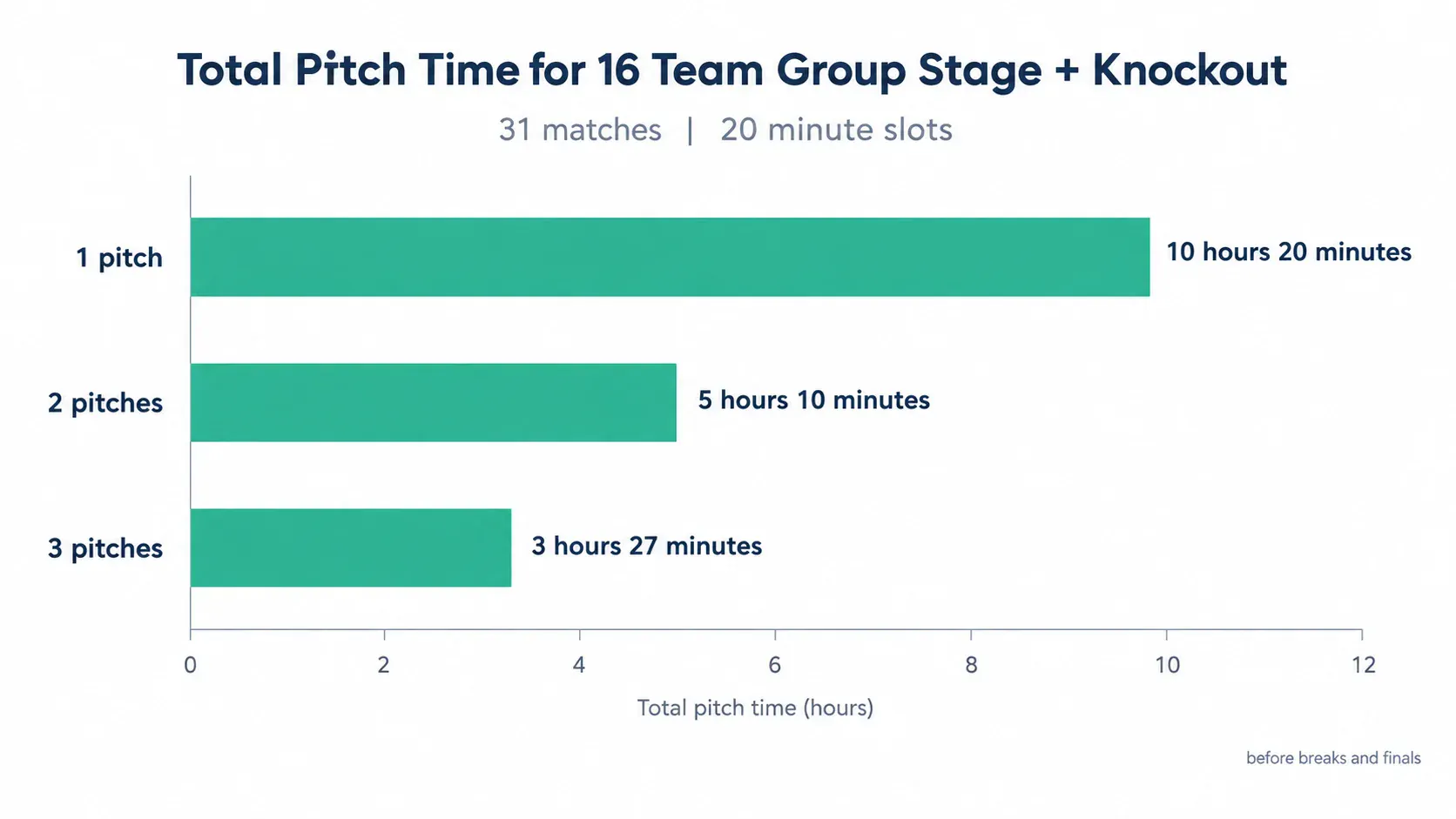
For a 16 team tournament that is 31 matches. At 15 minute games with a five minute turnaround, that is 310 minutes of pitch time, so two pitches gets you through in just over five hours before breaks. Three pitches brings it under three and a half. That calculation is the whole reason to do the sums first.
Scheduling the group stage across pitches
Group matches can all run at the same time, so the number of pitches is what sets the pace. Three things trip people up.
- Rest between games. If a team plays back to back on the same pitch while another team has a forty minute gap, you will hear about it. A good schedule alternates each group's fixtures so nobody plays twice in a row.
- The last round of group games. In any group where qualification is still open, the final round should kick off at the same time on adjacent pitches, so no team knows exactly what result they need. It is the same rule the World Cup uses, and it matters just as much at a sports centre.
- Late arrivals. Someone will turn up twenty minutes after their first game. Build a schedule you can move a fixture in without redoing the whole thing.
Scoryboard's fixture generator builds the group schedule around the pitches you have, spreads each group's matches so no team plays consecutively, and lets you drag any fixture to a different slot.
Tie-breakers, decided before kick off
Group tables end level more often than you would think, and arguing about it at 2pm with two semi finals waiting is not where you want to be. Publish the order before the tournament starts. The common order is:
- Points
- Goal difference
- Goals scored
- Head to head result between the tied teams
- Drawing of lots, or a penalty shoot out if both teams are still on site
Whatever order you choose, put it on the tournament page where every team can read it. Scoryboard applies the tie-breaker rules you set when it generates the standings, so the table on the big screen is already correct when the last group game finishes.
Give the runners up something to play for
The weakness of the format is that half the teams are finished by lunchtime. A plate competition fixes that. Teams that do not qualify from the groups go into a second knockout of their own, so every team is still playing in the afternoon and the car park does not empty at one o'clock.
Scoryboard supports plate and cup competitions for teams that do not qualify, so you can run both brackets from the same tournament without setting anything up twice.
Where to start
- Decide your entry size and check it against the match counts above.
- Confirm the total fits your pitch booking, with time for breaks and a final.
- Set the format in the fixture generator, add your pitches and match length, and let it build the schedule.
- Publish the tie-breaker order on the tournament page before the first game.
The free plan covers up to 8 teams, and one payment of £19.99 covers the whole competition with unlimited teams if the entry grows.
Generate your group stage fixtures
Frequently asked questions
How many teams do you need for a group stage tournament?
Eight is the practical minimum, as two groups of four feeding into semi finals. Below that a straight round robin is simpler and gives everyone more games.
Should teams play each other once or twice in the group?
Once, for a one day event. Playing twice doubles the group matches and rarely fits. Save home and away formats for a league.
What happens if group sizes are uneven?
Rank third placed teams across groups by points, then goal difference, then goals scored, and take the best of them to fill the knockout. Tell teams in advance that this is how it works.
Can the runners up still play after the groups?
Yes. A plate competition gives non qualifying teams their own knockout bracket in the afternoon, which keeps the whole entry involved until the end of the day.
Does the fixture generator handle the knockout draw?
Yes. The fixture generator takes the group standings and places the qualifiers into the bracket by seeding.